Agent Trust vs AI Safety vs AI Governance: What Product Managers Must Understand
A simple, product-focused breakdown of AI Safety, AI Governance, and Agent Trust—helping Product Managers understand the differences, why they matter, and how they impact AI product adoption.
Priyanka
5/3/20263 min read
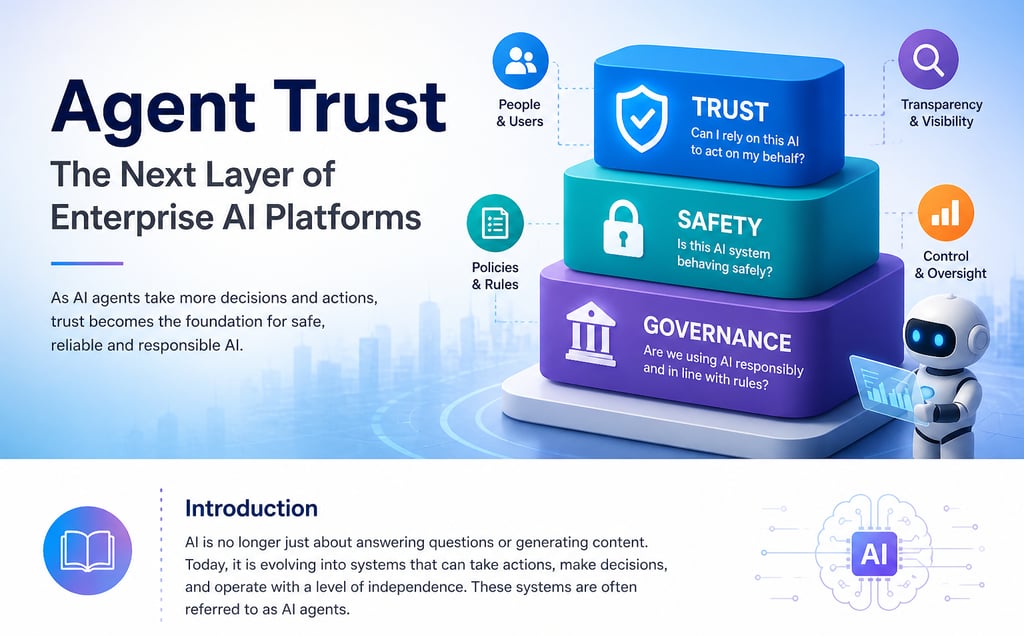
AI is moving beyond experimentation into real-world products. From copilots to autonomous agents, AI is now making decisions and taking actions, not just generating outputs.
As this shift happens, three terms show up everywhere:
👉 AI Safety
👉 AI Governance
👉 Agent Trust
They are often used interchangeably—but they are not the same.
For Product Managers, understanding the difference is critical. Why?
Because each one influences:
What you build
How you design it
How you measure success
And how customers adopt your product
Let’s break it down in a simple, practical way.
1. What is AI Safety?
AI Safety focuses on preventing harmful or unintended outcomes from AI systems.
It answers the question:
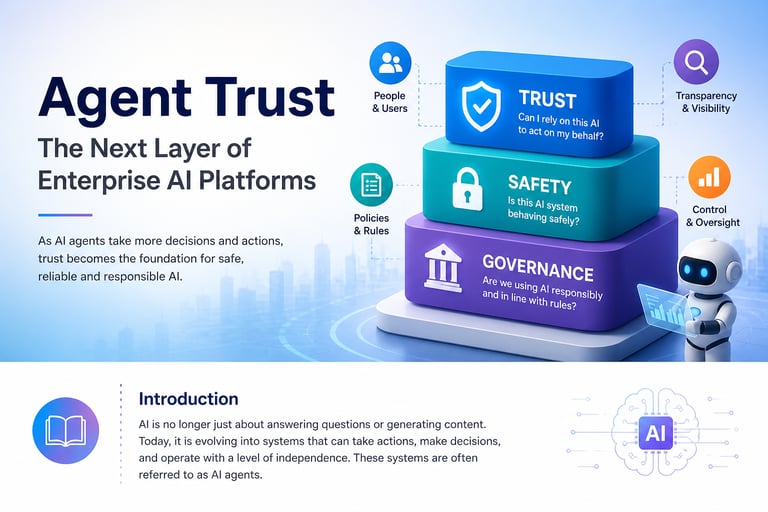
👉 “Is this AI system behaving safely?”
Simple examples:
Preventing toxic or biased outputs
Avoiding harmful recommendations
Ensuring the model doesn’t produce dangerous content
What PMs should care about:
Model guardrails (filters, constraints)
Testing for edge cases
Red-teaming and adversarial testing
Think of AI Safety as:
🛑 “Don’t let the AI do something harmful.”
2. What is AI Governance?
AI Governance is about policies, rules, and processes that ensure AI is used responsibly and in compliance with laws and standards.
It answers:
👉 “Are we using AI responsibly and in line with regulations?”
Simple examples:
Documenting how models are trained
Ensuring compliance with regulations
Keeping audit trails of decisions
Frameworks like NIST AI Risk Management Framework, EU AI Act and ISO 42001 emphasize governance practices such as accountability, transparency, and risk management.
What PMs should care about:
Auditability and traceability
Role-based access and approvals
Documentation and reporting features
Think of AI Governance as:
📜 “Are we following the right rules?”
3. What is Agent Trust?
Agent Trust is about whether users and organizations can confidently rely on AI systems to act correctly, transparently, and under control.
It answers:
👉 “Can I trust this AI to act on my behalf?”
Simple examples:
Can I understand why the AI took an action?
Can I control or stop it if needed?
Does it behave consistently over time?
What PMs should care about:
Visibility into decisions (explainability)
Control mechanisms (approvals, limits, overrides)
Reliability and consistency
Think of Agent Trust as:
🤝 “Would I trust this AI to do this for me?”
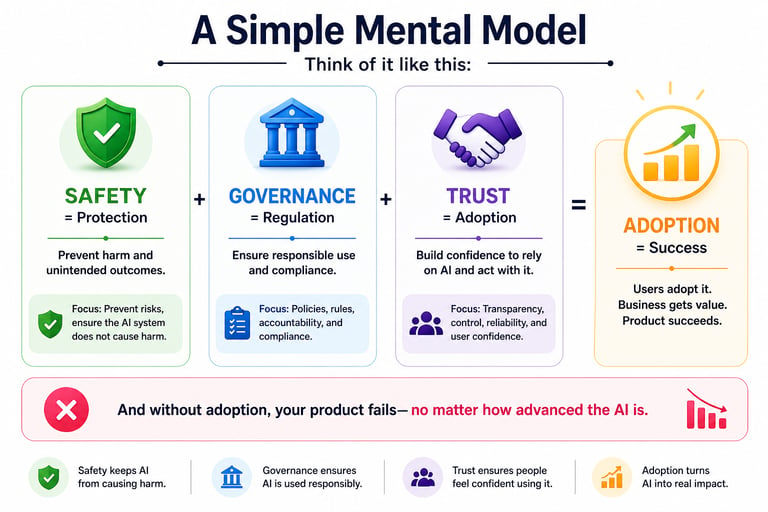
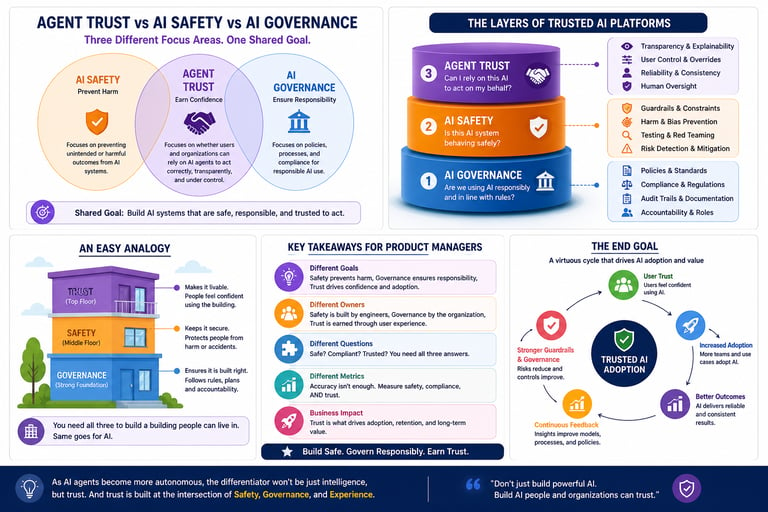
Let’s simplify the relationship:
Key insight for PMs:
Safety is technical (models and behavior)
Governance is organizational (policies and compliance)
Trust is experiential (user confidence and adoption)
👉 You can have safety and governance—but still lack trust if users don’t feel in control.
Why This Matters for Product Managers
As a PM, your role is not just to build AI features—it’s to ensure they are adopted and relied upon.
Here’s where many products fail:
They are safe but not usable
They are compliant but not transparent
They are powerful but not trusted
Example:
An AI system may:
Be safe (no harmful outputs)
Be compliant (well documented)
But if:
Users don’t understand its decisions
Or can’t control its actions
👉 They won’t use it.
That’s a trust failure, not a safety or governance issue.
How PMs Should Think About It
1. Design for Safety (Foundation)
Add guardrails and constraints
Test edge cases
Prevent harmful outcomes
2. Build for Governance (Structure)
Enable audit trails
Support compliance reporting
Define roles and responsibilities
3. Deliver Trust (Outcome)
Provide visibility into decisions
Enable user control
Ensure consistent behavior
The Opportunity for Product Managers
This is where PMs can differentiate.
Most teams focus heavily on:
Models
Accuracy
Performance
But the real opportunity lies in:
👉 Designing AI systems that users actually trust
This means:
Building explainable experiences
Creating control points
Designing intuitive workflows
Measuring trust, not just accuracy
Final Thoughts
AI Safety, Governance, and Agent Trust are not competing ideas—they are layers of a complete AI product.
Safety ensures AI doesn’t harm
Governance ensures AI is responsible
Trust ensures AI is used
As AI becomes more autonomous, trust becomes the deciding factor.
Because at the end of the day, the question isn’t:
👉 “Is this AI powerful?”
It’s:
👉 “Would you trust it to act for you?”